
Coffee sourcing

The coffee beans Nestlé responsibly sources from farmers around the world go into some of our most iconic brands - from Nescafé to Nespresso - bringing joy to millions of consumers every day.
We source most of our coffee from smallholder farmers, making them a key part of our global supply chain. With demand for coffee continuing to rise globally, coffee farming communities are often facing a range of complex economic and social challenges. That is why Nestlé is working to continuously improve our green (raw) coffee supply chain.
Key terms explained
Responsible sourcing
For Nestlé, responsible sourcing means improving the traceability of our ingredients and monitoring how they are produced. This involves applying our environmental and human rights requirements - detailed in our Responsible Sourcing Core Requirements (pdf, 2Mb) - at the different stages of our supply chain. Examples of these requirements include that land and resources of Indigenous peoples and local communities are respected and that no deforestation and no conversion of forests and other ecosystems occur in our supply chain.
Responsible sourcing
For Nestlé, responsible sourcing means improving the traceability of our ingredients and monitoring how they are produced. This involves applying our environmental and human rights requirements - detailed in our Responsible Sourcing Core Requirements (pdf, 2Mb) - at the different stages of our supply chain. Examples of these requirements include that land and resources of Indigenous peoples and local communities are respected and that no deforestation and no conversion of forests and other ecosystems occur in our supply chain.
Our progress
Learn more in the Environmental Disclosures section of our 2025 Non-Financial Statement (pdf, 18Mb).
Our approach to sourcing coffee
Regenerative farming
Meeting increasing demand for coffee without being able to improve yields in existing coffee growing areas has the potential to negatively impact fragile ecosystems. New coffee planting can increase the risk of forest clearing, reducing regional biodiversity, harming habitats and amplifying the effects of climate change.
To address this risk Nestlé is collaborating with coffee farmers to help them introduce regenerative agriculture practices that include the optimization of fertilizer use, agroforestry and intercropping.
This is taking place in many countries, including the seven origins where Nescafé sources 90% of our coffee - Brazil, Colombia, Côte d'Ivoire, Honduras, Indonesia, Mexico and Vietnam.
Key terms explained
Regenerative agriculture
In line with the Sustainable Agriculture Initiative Platform, Nestlé defines regenerative agriculture as an approach to farming which aims to conserve and restore natural resources, primarily soil, as well as water and biodiversity, while capturing carbon in soils and plant biomass, and to support farmers’ livelihoods. Examples of regenerative agriculture practices include reduced tillage and agroforestry. More information is available in our Nestlé Agriculture Framework (pdf, 19Mb). Read more about regenerative agriculture.
Regenerative agriculture
In line with the Sustainable Agriculture Initiative Platform, Nestlé defines regenerative agriculture as an approach to farming which aims to conserve and restore natural resources, primarily soil, as well as water and biodiversity, while capturing carbon in soils and plant biomass, and to support farmers’ livelihoods. Examples of regenerative agriculture practices include reduced tillage and agroforestry. More information is available in our Nestlé Agriculture Framework (pdf, 19Mb). Read more about regenerative agriculture.
Enabling farmers with new skills and high-yield plantlets
Nestlé enlists the expertise of agronomists around the world to support coffee farmers in achieving high-yielding harvests. For more than a decade, we've supported farmer training on good agricultural practices, such as pruning and agroforestry, to help improve efficiency and quality on their farms and diversify their crops.
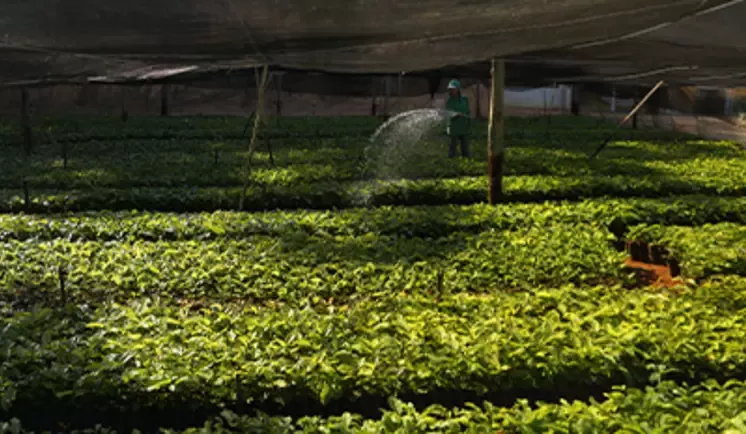
We also help renovate coffee farms by distributing superior coffee plantlets to farmers. We're working closely with coffee farmers across the globe, in places like Mexico and Vietnam. Since 2010, we're proud to have distributed more than 330 million high-yielding and disease-resistant coffee plantlets to farmers, which has aided the renovation of more than 150 000 hectares-equivalent of coffee farms worldwide.
Developing new and superior coffee varieties is also a big part of our approach. To help increase productivity, resiliency and quality, our research and breeding program developed and released 15 new and high-performing arabica and robusta coffee varieties in Mexico, Colombia, Ecuador, the Philippines, and Thailand.
Respecting the human rights of the people who grow our coffee
Our Nestlé human rights salient issue action plans help to assess and identify opportunities to strengthen our Human Rights Due Diligence (HRDD) mechanisms and policies at a corporate level and evaluate the implementation of those policies at the farm level, across all sourcing countries.
We are proud that Nespresso is the first brand within Nestlé to seek Fair Labor Accreditation (FLA) for its coffee sourcing program, the Nespresso AAA Sustainable Quality™ Program. In partnership with FLA, and our network of stakeholders from business, civil society, and academia, Nespresso has embarked on a comprehensive program with the goal of improving working conditions for all workers on coffee farms that grow Nespresso coffee.
FLA is a rigorous multi-year evaluation process with a simple goal: to better protect workers across global supply chains.
Industry recognition for our responsibly sourced coffee
Nestlé ranked first in 'coffee sustainability' in the new 2023 Coffee Brew Index, featured in the 2023 Coffee Barometer report. The report cited our cohesive and comprehensive coffee sourcing strategy with policies, objectives and actions that incorporate the social, environmental, and economic dimensions of coffee production.
Our brands in action
Nescafé Plan 2030
The Nescafé Plan 2030 (pdf, 100Kb) is an integrated action plan to support a more inclusive future for our coffee value chains. Nescafé is working with farmers to help them adopt regenerative agriculture practices that aim to contribute simultaneously to reducing carbon emissions, improving farmers' income and economic resilience, sharing farming best practices, and creating better social conditions. Independent assessments measure the impacts of these programs and help to improve our understanding of best practices.
We report annually on our progress. Learn more in the latest Nescafé Plan 2030 progress report (pdf, 14Mb)
Nespresso – The Positive Cup 2030
For over 30 years, Nespresso has been seeking to embed sustainability into its everyday business. Since 2013, this has been called The Positive Cup a strategy that remains at the heart of Nespresso's business and that reinforces its conviction that coffee must be a force for good. The Positive Cup Strategy towards 2030 introduces a new framework built upon Nespresso's strategic priorities and convictions: values-based, fundamental beliefs of the company, shaping the way it acts. Nespresso also reports performance against core KPIs related to each strategic priority.
We report annually on our progress. Learn more in the latest The Positive Cup progress report (pdf, 18Mb)