
Our packaging strategy
Our vision is that none of our packaging ends up in landfills or as litter.
Our work includes reducing our use of virgin plastic, piloting reuse and refill systems, and supporting well-functioning collection, sorting and recycling schemes across the countries where we operate.
We recognize the global infrastructure gap is significant – and not in our immediate control – but we are actively working to support successful collection and resource recovery systems with partners around the world.
Participation from all levels of society is needed. As a member of the Ellen MacArthur Foundation’s New Plastics Economy initiative, we are committed to playing an active role in the development of well-functioning collection, sorting and recycling schemes across the countries where we operate.
We also welcome new laws and regulations being introduced to improve the environmental profile of packaging and speed up the development of necessary infrastructure to collect, sort and recycle materials.
We actively advocate for harmonized and better regulation of post-consumer resources and call on governments to accelerate progress on infrastructure development. We advocate for a legally binding UN Treaty on Plastic Pollution, which we hope will lead to new, harmonized national regulations.
How we are working to reduce our packaging
0.86
Million metric tonnes
* Recyclable. As defined in the Ellen McArthur Foundation definitions, a packaging or packaging component is recyclable if it is successfully post-consumer collected, sorted and recycled with a recycling rate of 30% in multiple regions, collectively representing more than 400 million inhabitants.
Reusable. Following ISO 18603, reusable is the characteristic of a product or packaging that has been conceived and designed to accomplish within its lifecycle an expected number of trips, rotations or uses for the same purpose for which it was conceived. The weight of reusable packaging is defined by the total weight of reusable packaging, divided by the number of expected rotations over the entire life of the package.
Compostable. According to ISO 18606, a material is compostable (home or industrial compostable) if through microbial activity its biodegradable components produce compost, also CO2 and water, and in the case of anaerobic digestion, also methane.
Learn more in the Environmental Disclosures section of our 2025 Non-Financial Statement (pdf, 12Mb).
Our five-pillar packaging strategy

Less packaging – Reduce
Less packaging – is about reducing our use of virgin packaging material in general.
Examples of how we are doing this include removing unnecessary plastic lids, accessories, layers and films, and in some countries, phasing out packaging items that are not widely recycled.
We launched several packaging innovations in Latin America: redesigning our Nescafé single-serve stick packs of coffee and Mahler Bouillon to reduce the plastic used in packaging by more than 200 tonnes combined.
In China, Nescafé light-weighted the ready-to-drink coffee bottles saving 1733 tonnes of plastics annually.
Recycled content vs. virgin material in 2025
Percentage
-
40.8% Recycled content
-
59.2% Virgin material

Less packaging – Reuse and refill
To reduce the need for disposable packaging, we explore using innovative reusable and refillable packaging systems where it makes environmental and economic sense while fulfilling consumer needs. Widespread adoption of these systems requires industry collaboration & supportive legislation.
Reuse and refill are alternative delivery systems (ADS) in which packaging is either refilled and reused by a consumer, before it is returned to the manufacturer for cleaning, relabeling and reuse several times, before ultimately being recycled. Reuse models are generally divided into 2 broad categories, Refill and Return according to the Ellen MacArthur Foundation.
In a reuse model, once the product has been consumed, the empty packaging is returned to a drop-off point or picked up at home as it is intended to be used multiple times without significant modification or loss of function. In a refill model, users refill their reusable container at home or on the go.
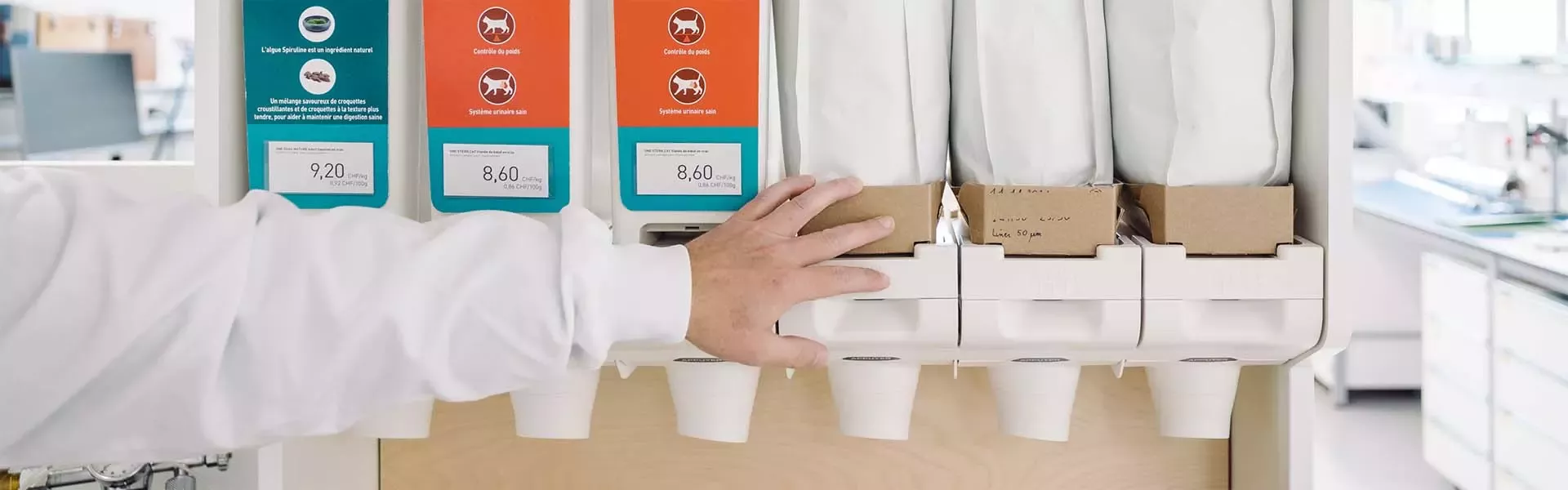
In the past years, we have had over+20 pilot consumer solutions in different markets around the world, that includes:
- Refillable dispensers in Indonesia, which have been developed with technical partner Algramo and non-profit incubators Enviu. The new systems have been piloted for Milo and Koko Krunch in partnership with local retailers in Indonesia.
- Reuse solution in Germany, we ran a pilot with Circolution. working in several grocery stores. The team tested new standardized reusable stainless-steel packaging for Nesquik, which can be integrated with existing return and cleaning infrastructure.
For our transport packaging, innovations have helped us replace the plastic shrink-wrap on our pallets, while switching to reusable shipping boxes, and big bags for interfactory reuse. We recognize that more needs to be done and are collectively working with different coalitions, such as Consumer Goods Forum and the Ellen MacArthur Foundation. along the value chain to enable conditions to scale up reuse, including legislation to mandate reuse, standards for poor packaging, decarb of transport and consumer incentives.

Better packaging – Redesign
We are collaborating with industrial partners to develop new packaging materials and solutions. Better packaging means creating simpler, improved recyclable and innovative materials that keep products safe while working to ensure that the packaging is suitable for recycling systems, and aligned with them.
Across our portfolio, we are continually evaluating our materials and testing and introducing alternatives, such as recyclable paper for Maggi bouillon cubes in France, to replace multi-material wrappers, or compostable paper-based coffee pods to replace plastic with Nescafe Dolce Gusto. Dolce Gusto NEO pods in Brazil are certified for industrial composting. This means they can be properly processed at the end of their life, reducing landfill waste and helping lower carbon footprint while maintaining the quality and convenience consumers expect.
By the end of 2025, 87.5% of our plastic packaging had been designed for recycling. We continued to improve the recyclability of our plastic packaging and will keep building on these efforts, including by supporting the development of collection and recycling infrastructure. Learn more in the Environmental Disclosures section of our 2025 Non-Financial Statement (pdf, 12Mb).
Better system – Recycle
We are continuing our efforts across our global operations to prevent plastic waste from leaking into the open environment.
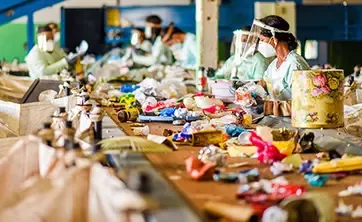
We support collection, sorting and recycling infrastructure in the countries where our products are sold and, in some countries, aim to collect and recycle the same amount of plastic as we use in our products under a “one tonne in, one tonne out” principle.
For example, in Malaysia, Nestlé joined forces with Petaling Jaya City to launch a door-to-door collection and recycling program as a voluntary recovery initiative. This pioneering program has been recognized by both the United Nations Environment Program (UNEP) and the Ministry of Environment Malaysia as an example of separation-at-source best practice.

Better system – Rethinking behaviors
Addressing the plastic waste challenge requires fundamental behavioral change from all of us, including Nestlé, retail partners, suppliers and consumers.
We have rolled out Packaging Sustainability training for our employees, and aim to educate and encourage others through a diverse range of programs and campaigns, helping everyone imagine a waste-free future. Examples include Nespresso’s capsule collection program videos, the Dove Lo Butto digital platform in Italy, which helps customers identify the nearest location to dispose of their packaging waste, and Nescafé Dolce Gusto consumer education campaigns in Germany and Mexico.
In the United States, Nestlé Health Sciences have eliminated hard-to-collect and recycle over-cap seals for vitamins and supplements. Our brands Pure Encapsulations and Atrium Innovations supported the innovation with a digital campaign.
In Brazil, France and Switzerland our coffee brands Nescafe Dolce Gusto and Nespresso launched compostable coffee pods. A digital campaign, together with on-pack information encouraging the separation of household organic waste and compostable materials, raised awareness among consumers.
On our packaging, we have standardized our back-of-pack communication globally for all products to ensure we help guide consumers to "Dispose Responsibly". This effort began in 2023 and continues on a rolling basis with each packaging redesign. This includes: a) Environmental claims (statements, symbols or graphics) for packaging that indicates an environmental aspect of our packaging or a component of the packaging (e.g., recycled content); b) Material composition of the packaging to facilitate consumer sorting; c) Disposal instructions; d) Information on the end-of-life of packaging (e.g., recyclable, reusable), including the logo depicting packaging waste management programs established in partnership with third parties.